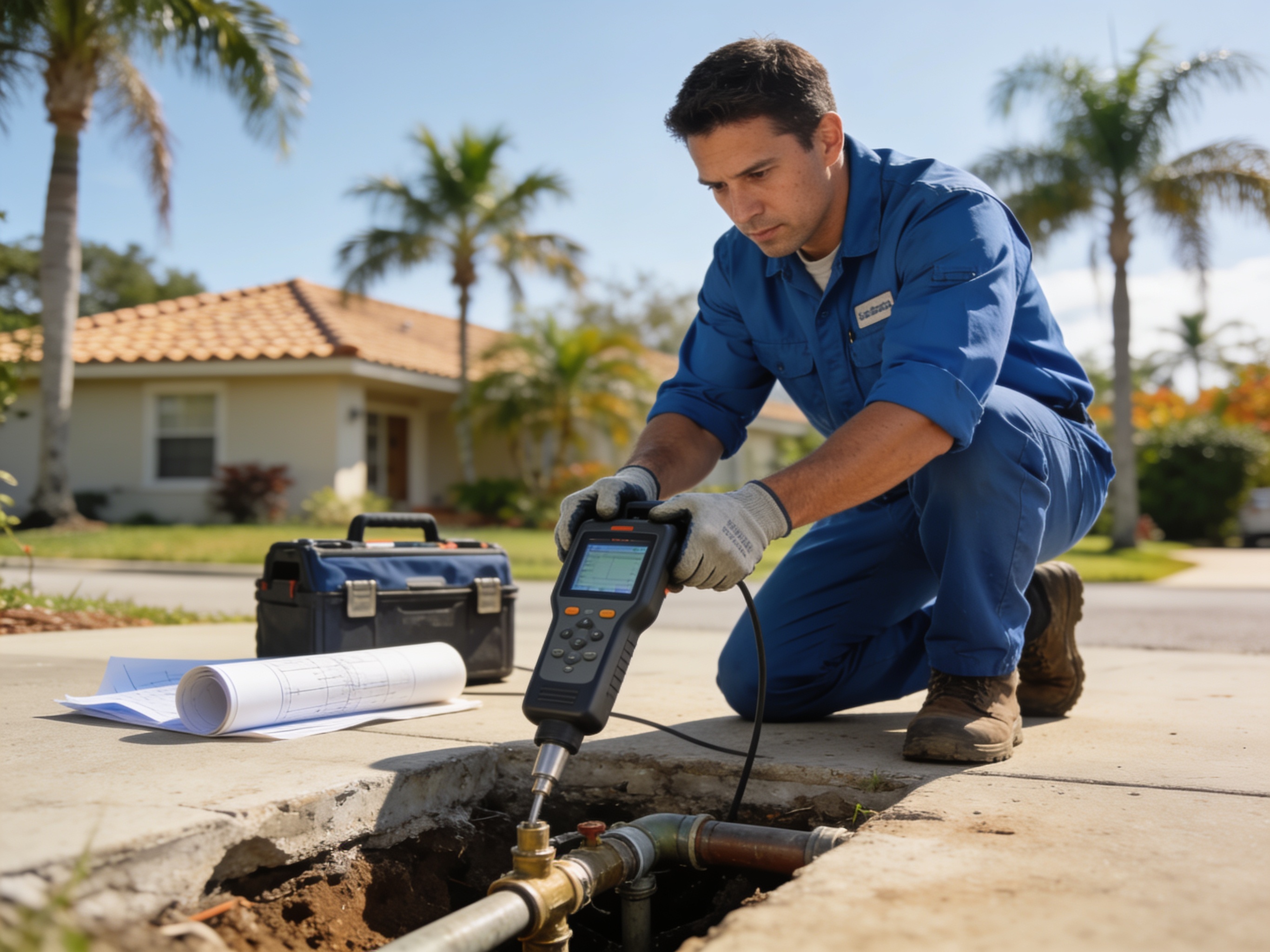
When You Need It
Leak problems rarely announce a single location. They usually appear as a set of symptoms that point toward a hidden source. The following situations are worth investigating:
- A water bill has risen with no visible cause. A higher bill is a symptom to investigate, not proof of a leak on its own.
- You hear running water when every fixture and appliance is switched off.
- The water meter moves when no fixture is open.
- A damp patch appears on drywall or flooring, tile feels warm in one spot, or paint bubbles on a wall.
- A room or closet smells musty and never seems to dry. Where growth is visible, the area should also be assessed through Mold Inspection.
- Water appears somewhere far from any fixture, such as the far side of a room or at the base of a wall that has no plumbing on its face.
The reasoning behind all of these signs is the same. Water travels along framing, subfloors, insulation and cavities before it shows itself. The wet place is therefore rarely the leak place. A stain on a ceiling may come from a line several feet away, and a warm patch on tile may be heat from a pipe running under the slab. This is why leak detection is a discipline rather than a quick look. Acting on the first visible sign usually means opening the wrong area first.
Some signs are easy to dismiss because they are small. A meter that creeps, a faint sound at night or a single soft spot on a floor can each seem too minor to act on. Taken together with the others, they often describe the same hidden route. Recording when each sign appears, and whether it happens with fixtures closed, helps separate a leak from ordinary use. Timing matters too: a sign that appears only after showers or irrigation points to a different route than one that persists overnight. Each sign narrows the question, even when none of them answers it alone.
If you notice several of these signs at once, or if the signs keep returning after surface repairs, the search should begin before more material is removed.
How the Work Runs
Every detection job follows the same order. Each step builds on the one before, so the search starts on the right system and the openings stay as small as the evidence allows.
1. Call and history
The first conversation covers what you have noticed, when it started and what has changed since. Useful details include bill changes, sounds, stains, recent plumbing or irrigation work and any appliances that were added or replaced. Call Florida Water Damagesolution today to start the assessment, and bring the most recent water bills if you have them. This history tells the search where to look first.
2. Isolation
Supply and drain leaks behave differently, so the next step separates them. Meter and fixture tests show whether water is moving through the supply system with everything closed, and whether a drain or irrigation line may be the cause. The aim is to place the search on the correct system before anything is opened.
3. Instrument search
Once the system is identified, moisture mapping traces the path the water has taken. Acoustic listening and thermal imaging are used where they help. These are process methods: acoustic listening picks up sound from a pressurised line, and thermal imaging shows temperature patterns along a run. Neither method locates a leak on its own, and each is used alongside the other evidence.
4. Confirmation
The source is confirmed with the smallest targeted opening that proves it. Evidence comes before demolition. If the evidence points to one spot, only that spot is opened. If it does not, the search continues before anything else is removed. Openings are kept to the minimum needed to see the source. Each opening is logged with its location, size and the evidence that justified it, so the record shows why the opening was made.
5. Findings documented
The leak's location and the water's reach are recorded with photographs and readings. This record serves the owner's own file and the trades that follow, including any plumber and any restoration crew. Clear documentation also helps if the property later needs to be assessed against local permitting rules. The written record lists the systems tested and the readings taken, so anyone reading it later can follow the reasoning.
6. Handover
Repair of the leak is carried out by a plumber, and that work is outside the scope of this page. Restoration of any water damage from the leak is sequenced next, through Water Damage Restoration. Where materials are still wet, drying is handled through Structural Drying and Dehumidification so the structure is not closed up while moisture remains.
What's Inside This Service
Leak detection is made up of four connected methods. Each one suits a different kind of evidence, and each has limits that the search takes into account.
(a) Meter and isolation testing
Meter and isolation testing starts with the water meter. With every fixture closed and every water-using appliance switched off, the meter should sit still. If it keeps moving, water is leaving the system somewhere. The test then separates the house supply from the drain side and from irrigation and pool lines, since each can lose water in a different way. Isolating one system at a time tells the search which system to explore first. The readings are noted at the start and end of each test, so any change is clear. Each result is written down before the next isolation step begins. What drives the cost of this step is the number of systems that must be isolated, how many fixtures and zones are involved and whether the property's valves allow clean separation.
(b) Moisture mapping
Moisture mapping uses moisture meters to trace the wet path back toward the source. Water rarely sits where it enters. It spreads along framing, subfloors and insulation, so the readings form a map of where the water has gone. The map leads the search, not the stain, because a stain is often the last visible point of a much larger wet area. Readings are taken in a consistent grid and recorded, so the path can be followed and checked again. Mapping is repeated after drying or after a suspected repair, so the readings show whether the wet area is shrinking or still growing. Dry areas are mapped too so the edge of the wet zone is clearly marked. The cost depends on how large the wet area is and how many surfaces the mapping must cover.
(c) Acoustic and thermal methods
Acoustic listening is used for pressurised supply leaks, where escaping water makes a sound that can be traced through the structure. Thermal imaging looks for temperature patterns that show a line's run, because a water line can leave a warm or cool trace across a floor or wall. Both methods have honest limits. Sound can travel far from its source, and temperature changes can come from sunlight, appliances or insulation. Neither method is used alone, and results are checked against the isolation and moisture evidence. Listening is done in quiet conditions with fixtures closed, because background noise can hide the sound of a small leak. Thermal readings are compared against a reference area. The cost depends on access to the surface being tested and the amount of checking needed to rule out false readings.
(d) Slab and in-wall leaks
Cape Coral has two common hiding places for leaks: beneath slab-on-grade floors and inside walls. A slab leak usually produces warm patches on tile, damp flooring, a rising water bill or a sound of running water with everything switched off. An in-wall leak usually produces stains, bubbling paint, soft drywall or a musty area that never dries. Each is confirmed differently. A slab leak is confirmed by isolating the line and locating it with listening and thermal methods before any concrete is opened. An in-wall leak is confirmed by mapping the moisture and making a small targeted opening in the wall. The cost depends on the number of runs, the access to each one and whether confirmation openings must be made.
Leak Detection and the Property's Paperwork
Hidden leaks can become a paperwork matter when the repairs grow. In Cape Coral, the City's Substantial Improvement and Substantial Damage (SI/SD) framework applies, and the SI/SD application sits within the building permit submittal. The City's published checklist states that damage of any origin counts toward the substantial-damage definition, and that the threshold is 50% of pre-damage market value. Whether a long-running leak counts is for the City to determine.
The City's checklist also says the applicant's photographs play a critical role in the determination.
A documented detection is the start of that file. The location of the leak, the reach of the water and the readings taken during mapping are the evidence an owner can keep. Detection findings are evidence for the owner. Determinations about substantial damage belong to the City of Cape Coral. Plumbing repair belongs to a plumber. This page does not file the City's paperwork, does not secure approvals and does not promise any outcome under the SI/SD rules or under an insurance policy. The most useful step is to keep clear photographs and written findings from the start, so the owner can present them if the City asks.
The file an owner builds is practical rather than legal. It records what was found, where it was found and how far the water travelled, using the same evidence the detection process produced. Keeping that file in order from the first visit means the facts are already written down if a question arises months later. Each photograph should show a clear view of the area and carry a date, and each reading should be tied to a location on a simple sketch or list. Nothing in the file needs to be argued at the outset; it only needs to be accurate and complete. The City, not the owner, decides how that file is weighed.
What Leak Detection Costs Depend On
The cost of leak detection depends on the work the search requires. It is not a fixed sum, and no figures are given here. Several factors apply, and they often overlap. The factors that shape it are:
- How many systems must be isolated. A search limited to the house supply costs less than one that must separate supply, drain and irrigation lines.
- Access to the suspected runs. Lines behind finished surfaces, under slabs or in tight cavities take more time to reach than exposed runs.
- How much mapping the water's path requires. A small, clear wet area needs less mapping than water that has spread across several rooms.
- Whether confirmation openings are needed. Some leaks can be confirmed without opening anything. Others need a small targeted opening, and the number and size of those openings depend on the evidence.
- Whether slab or in-wall runs are involved. Concealed runs under slabs or inside walls usually take more checking before a source is confirmed.
The search follows the evidence in order. Each step either narrows the location or rules out a system, and findings are shared as they firm up, so the owner understands the reasoning as the work progresses. The owner receives an explanation of which factor is driving the work at each stage. The estimate is revisited as the evidence changes. Each factor is weighed on site, once the evidence is in view, rather than estimated from a distance. This process is a clear description of how the search runs, not a promise about the final outcome or the total effort it will take.
Questions People Ask
Can a leak be found without tearing out walls and floors?
Often, yes. Isolation tests, moisture mapping, acoustic listening and thermal imaging can narrow the search to a small area before anything is opened. Some leaks, however, cannot be fully confirmed from the surface. In those cases, a small targeted opening is the honest next step. It is made only where the evidence points, so the material removed stays as limited as the situation allows, and the reason is recorded.
My water bill jumped but I cannot see any water. What is checked first?
The first check is the meter and isolation sequence. With every fixture closed and every water-using appliance switched off, the meter should stay still. If it moves, water is leaving the system. The test then separates the house supply from drain and irrigation lines, so the search starts on the right system. A bill increase is a symptom to investigate, not proof of a leak on its own, so the history of recent changes is also recorded and dated, alongside the readings.
Is a slab leak detectable?
Yes, using the methods described for slab and in-wall leaks. The isolation test shows whether the line is likely to be the cause. Acoustic listening can pick up sound from a pressurised line, and thermal imaging can show temperature patterns along its run. Moisture mapping shows where the water has spread. These methods are used together, and the line is confirmed before any concrete is opened. Their limits are taken into account throughout the search, and each step is explained as it happens.
Do you repair the pipe once it is found?
No. Repair is a plumber's work, and this page does not offer it or arrange it. Florida Water Damagesolution's part is the detection, the documented findings for the owner's file and the water-damage sequence that follows. That sequence covers restoration through Water Damage Restoration and drying through Structural Drying and Dehumidification where materials are still wet. Call Florida Water Damagesolution to arrange the visit if you need the leak located first.