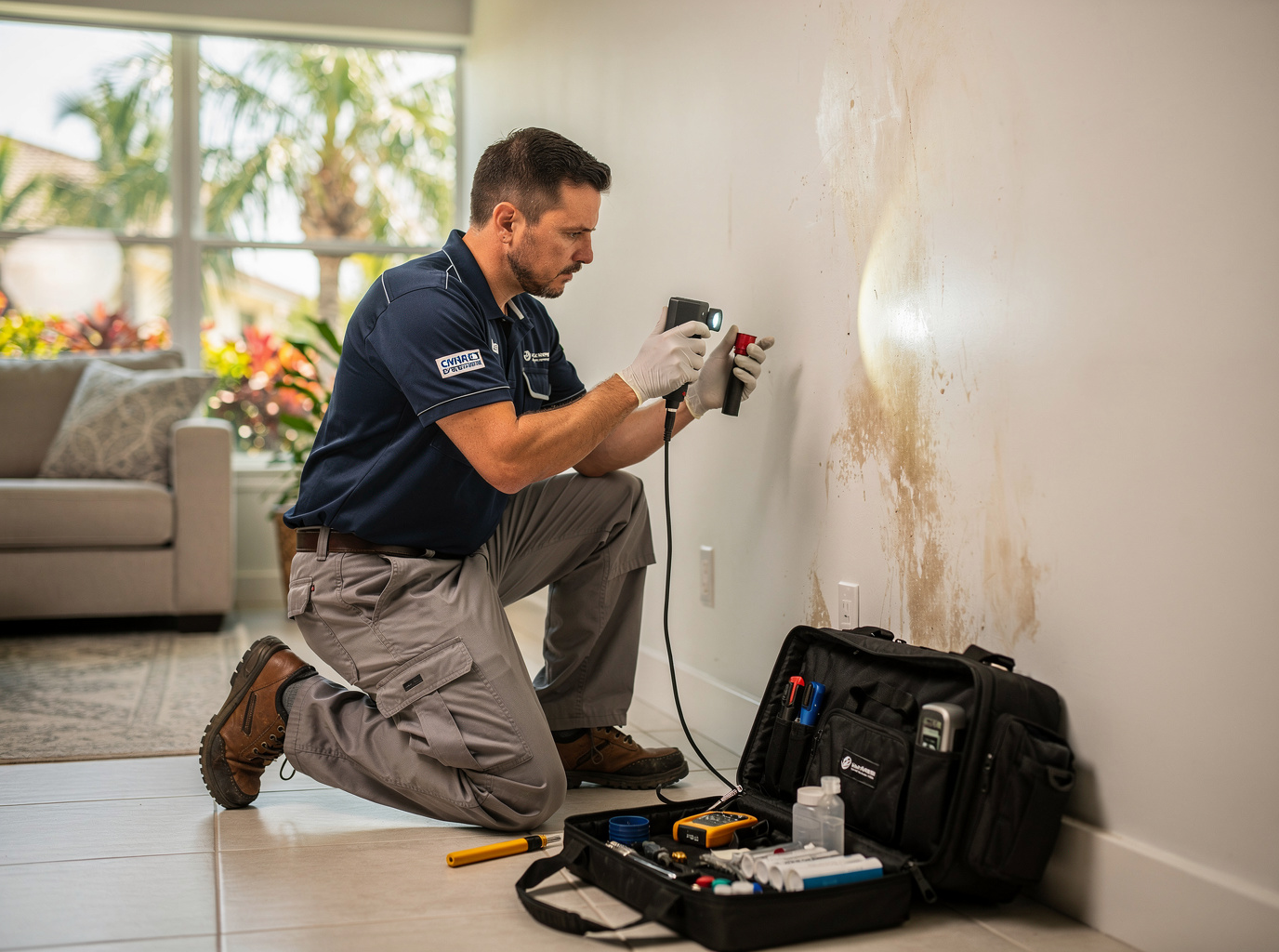
2. When You Need It
An inspection makes the most sense when you need facts before you decide what to do next. Common situations include:
- A musty odour with no visible source. The smell is real, but the growth may be behind a wall, under flooring or inside a cabinet. An inspection looks for where it is. The inspector starts with the spaces closest to the smell, then follows the moisture readings outward to see where damp material sits.
- Visible growth where the full extent is unclear. A stain on one wall can connect to damp material in the next room. An inspection maps the whole area. Mapping shows where the visible growth stops and where damp material continues, so the edge of the affected area is recorded rather than guessed.
- After a leak, flood or storm, once the property is dry. Drying can hide evidence. A post-event inspection shows what drying did not fix. The record notes which materials still read damp, which show staining, and which appear to have dried, so the remaining work is clear.
- Before remediation. An inspection scopes the job so that removal is limited to what was actually found. The findings give any remediation a documented starting point, so the work can be planned against the written record.
- After remediation. An inspection confirms the corrected condition through a visual and moisture check. It is a verification of what is visible and measured. It is not a clearance test. The inspector walks the same areas recorded before, checks the readings against the earlier findings and notes what has changed.
- During a property transaction. Some parties want a documented record of mold conditions at a given point in time. An inspection provides that record. It does not take a position on any legal or disclosure question, which is for the parties and their advisers. The written record sets out the conditions seen on the date of the visit, which the parties can read alongside their own documents.
If you are not sure which situation applies, describe the history of the property when you call. Call Florida Water Damagesolution to talk through what happened and what has already been cleaned or removed.
3. How the Work Runs
Step 1: Call and history
The process starts with a conversation. We want to know where the concern is, what happened, and when. A leak, a flood, a long-running odour and a recent storm each point the inspection in a different direction. We also ask what has already been cleaned, removed or repaired, because earlier work can change what the inspector sees. This is the step where the scope of the visit is agreed before the work begins.
Step 2: Visual inspection
The inspector walks the suspect rooms and the places where growth tends to hide. These include the space under sinks, the area around air handlers and vents, bathrooms, water heater and laundry areas, and any prior leak site. The inspector checks surfaces for staining, discolouration, warping and lifted finishes, and looks at the condition of the materials behind what can be seen.
Step 3: Moisture investigation
Moisture meters and moisture mapping show which materials are holding water. Readings are taken on walls, floors and ceilings around the growth and recorded across the area. Where the moisture points to a source that cannot be reached, such as a pipe inside a wall, the inspection moves to a source hunt. If the source is hidden, we link the work to our leak detection service.
Step 4: Findings documented
Every finding is written down. The record shows the location of each area, its approximate extent, the moisture readings taken and the photographs of conditions as found. Each entry is tied to a point in the property, so the record can be read room by room and compared with later visits. The written record is the document you keep.
Step 5: What the findings mean
The findings are read honestly. Some areas will need remediation because growth is established or the moisture source is still active. Other areas may need only drying or cleaning. The inspection states which is which and why. This is guidance based on the findings, not a promise about the final outcome. If remediation is needed, our mold remediation service handles that work as a separate job.
Step 6: Close-out
The documentation is handed over at the end of the visit. The next steps are in your hands. Before the visit ends, the findings are reviewed with you so that the record is clear and you know which document holds which information. You decide whether to act on the findings, to ask for remediation, to repair the moisture source, or to keep the record for later use. The record is an assessment, not a guarantee of the final outcome, and you keep it after the visit.
4. What's Inside This Service
Visual assessment
Visual assessment is where an inspection starts. The inspector walks the suspect rooms and checks the places where growth tends to hide, including the back of cabinets, under sinks, around air handlers and supply vents, bathroom corners and caulk lines, behind water heaters and washers, and along any prior leak site. The inspector reads staining, discolouration, warped trim, lifted finishes and the condition of the materials. Surface growth on a painted wall is read differently from growth that has spread into porous materials such as drywall, insulation or wood. When growth appears established, the findings say so and describe its extent. This report does not name species, because a visual read cannot support that claim. Visual assessment is needed whenever growth is suspected or a space has a history of water. Its cost depends on the number of rooms and how hard the surfaces are to reach.
Moisture investigation
Moisture investigation explains the growth. Mold is usually a symptom, so the real product of the inspection is the moisture story: where water came from, where it went, and whether the building is still holding it. Meters are used on walls, floors and ceilings around the growth, and readings are mapped so wet and dry zones show clearly on paper. Readings are compared with nearby materials that are sound, which is how a damp wall is separated from a wall that only looks stained. Cape Coral's humidity and air conditioning condensation can keep materials damp with no leak at all, and that pattern is recorded. This service is needed when the cause of growth is unclear. Its cost depends on how much mapping the source hunt requires.
Documentation
Documentation turns an inspection into a usable record. Findings are written up with the location of each area, its approximate extent, the readings taken and the photographs of conditions as found. Locations are described by room and surface, so a later visit can check the same points and show whether anything has changed. The record can be kept by the owner, used to compare against a later inspection, or passed to a professional who works on the property. After a flood, this matters more, because the City's flood review relies on photographs supplied by the applicant. Labelled, dated photographs taken during the assessment give the owner a practical starting file. The inspector records what is seen and measured and does not make determinations that belong to the City. Its cost depends on the number of areas photographed and the level of detail the owner asks for.
Post-event inspections
Post-event inspections follow a leak, flood or storm once the property is dry enough to assess. Water often leaves growth in places that were out of sight while it was present, and drying can hide evidence until materials are opened or re-measured. A post-event inspection adds an assessment after drying. It records which materials have held moisture, where growth has started, and which areas need remediation before rebuilding. The sequence is simple: the assessment comes first, so removal and source correction are scoped to what was found, and a later visual and moisture check confirms the corrected condition. Its cost depends on the size of the affected area, how long water stood, and how closely the inspection must be coordinated with drying and repair work.
5. Inspections in Cape Coral's Flood Framework
After flood events in Cape Coral, the City's substantial improvement and substantial damage (SI/SD) process runs on documentation. The City's published checklist explains that the SI/SD application is part of the building permit submittal and that photographs of the building play a critical role in the determination, with the applicant providing them. Under the federal 50% framework that the City applies, substantial damage means damage of any origin, including flood, whose restoration cost equals or exceeds 50% of the structure's pre-damage market value.
This means a documented inspection record has a practical place in a flood-damaged property's file. A written inspection shows the condition of the building as found, the moisture readings, and the photographs taken during the visit. Owners who are preparing SI/SD paperwork may find this record useful when they assemble their own materials for the City. After a flood, an owner is often dealing with repairs, drying and paperwork at the same time, and a dated record of conditions helps keep that work in order. The record is the owner's own document, and it does not replace the City's review.
The inspection does not decide whether a building is substantially damaged. That determination is made by the City and its Floodplain Administrator, using the market value and documentation the City requires. The inspection records conditions and measurements. It does not state whether the damage exceeds the 50% threshold, and it should not be read as a determination on that question.
A mold inspection can help define what has been affected, but it cannot promise a permit outcome, a compliance result or any claim decision. Those are matters for the City and for the owner's own professionals. If your property is a flood-damaged building in Cape Coral, call Florida Water Damagesolution to discuss how an inspection record can sit alongside the City's paperwork. Read more about water damage restoration in Cape Coral.
6. What a Mold Inspection Costs Depend On
Cost depends on the work involved, and the factors below explain why one inspection differs from another. No prices or ranges are given on this page.
- Property size and number of areas. A single bathroom takes less time than a whole home with several suspect rooms. Each added room adds its own visual pass and readings, so the total grows with the number of areas.
- Access. Attics, crawlspaces and areas behind fixtures take more time to reach and inspect safely than open rooms. Hard-to-reach spaces need more set-up and more care, which is why access is checked early in the call.
- Moisture mapping required. A simple visible area needs less mapping than a source hunt that spans several walls and floors. Each wall or floor that needs readings adds mapping work, and a hidden source adds the search itself.
- Flood or storm context. An inspection that follows a flood event, and that must support the documentation the City asks for, requires more photographs and a fuller written record. The extra photographs and written detail follow from the documentation the City relies on.
- Documentation level. The depth of the written record, and how many visits are needed to verify conditions, affects the work. A fuller record takes longer to write and photograph, and repeat checks add their own time.
The process is open from the start. Before an inspection begins, we agree on what it will cover, which areas it includes, and what the written findings will contain. Nothing is started on the basis of an assumption. The scope is agreed first so that you know what you are getting.
7. Questions People Ask
What does a mold inspection actually check?
A mold inspection checks the areas where growth is suspected, along with the places where growth tends to hide. The inspector looks at surfaces for staining, discolouration, warping and lifted finishes, and checks areas such as under sinks, around air handlers, bathrooms, water heater and laundry areas, and prior leak sites. Moisture meters are then used to find damp materials, and the readings are mapped. Everything is recorded in a written report with locations, extent, readings and photographs. The inspection describes what is seen and measured. It does not name species or make claims about health.
Is a mold inspection the same as mold testing?
No. As Florida Water Damagesolution offers it, a mold inspection is a visual assessment, a moisture investigation and a written record of findings. It is not laboratory testing. Lab analysis is not part of this service, so the report is based on what the inspector sees and measures on site. If you want to understand what an inspection can and cannot tell you, ask us during the first call, and we will explain the scope before the visit.
Should I get an inspection before remediation?
In most cases, yes. An inspection tells you where growth is, how far it reaches and what moisture is feeding it. That information lets the remediation work be scoped to what was actually found. Remediation covers removal and correcting the moisture source, and that work is handled by our mold remediation service. Inspection is the assessment that comes first. After remediation, a later inspection can confirm the corrected condition through a visual and moisture check.
I can smell mold but cannot see it. Can an inspection find the source?
An inspection can often narrow down the source. The moisture investigation uses meters and mapping to find damp materials, and the pattern of readings points toward where water is entering or collecting. If the source is hidden inside a wall, under a floor or behind a fixture, the inspection will say so and recommend a targeted search. For a hidden supply or drain leak, our leak detection service locates hidden leaks.