When You Need It
Water damage calls for attention as soon as you notice it, even when the visible problem looks small. The signs below are the usual trigger situations in homes and buildings across Cape Coral.
- Standing water on floors, in closets, or under sinks and cabinets.
- Soaked flooring, including carpet that feels wet underfoot, laminate or tile that has lifted, and baseboards that have swelled.
- Drywall or ceilings that are stained, bubbling, soft or sagging.
- A leak you can hear, or a water meter that keeps moving while nothing is running, but you cannot see where the water is coming from.
- Water that entered during or after a storm, through doors, windows or roof edges.
- A musty odor after a known leak. This can point to mold growth in hidden spaces, which is covered on the mold remediation page.
Water does not stay where it lands. It travels along the underside of flooring, through gaps around baseboards, and into wall cavities, where it can keep spreading without leaving a visible sign. Building materials keep absorbing moisture for as long as they stay wet. The longer water remains, the more material may need to come out, and the more likely it is that finishes and structural parts that were fine at the start will be affected.
That is reasoning about how water behaves in a building. It is not a timetable. How quickly damage grows depends on the materials, the amount of water, how it entered, and the conditions inside the property. A small leak found early usually leaves less to open up and rebuild than one that has been running behind a wall for months, so the sensible approach is to start the assessment early rather than wait to see how bad it gets.
Storm events raise the same questions. Wind-driven rain can enter through a gap that is hard to notice from inside, and water that rose during a flood can leave moisture in wall bases and under floors long after the water itself has drained. If you are not sure whether a problem is a plumbing leak, a storm intrusion or floodwater, say so when you call. The category of water changes the handling, and it helps to know that at the start.
Call Florida Water Damagesolution to describe the signs you are seeing. A short conversation at this stage makes it easier to decide what should happen first.
How the Work Runs
Restoration follows a fixed order because each step depends on the one before it. Skipping ahead, such as drying a wall that is still taking in water, wastes time and can leave moisture behind. Here is how a typical job runs.
1. Call and assessment
The job starts with a call in which you describe what happened, when you noticed it and where the water is. Reach Florida Water Damagesolution to arrange the visit. On site, the source and the extent of the damage are assessed. Before anything is moved or removed, the damage is documented with photographs as found. That record matters later because it shows the condition of the property at the start, and the City of Cape Coral's flood paperwork also relies on photographs, as explained in the flood zone section below.
2. Source control
Active water has to stop before drying can work. That may mean shutting off a supply line, isolating an appliance, clearing a blocked drain or sealing an opening that lets rain in. Hidden sources are often the hardest part. When the origin of the water is not visible, the work moves to finding it using moisture evidence and targeted investigation. The leak detection service covers that step in depth.
3. Water removal and extraction
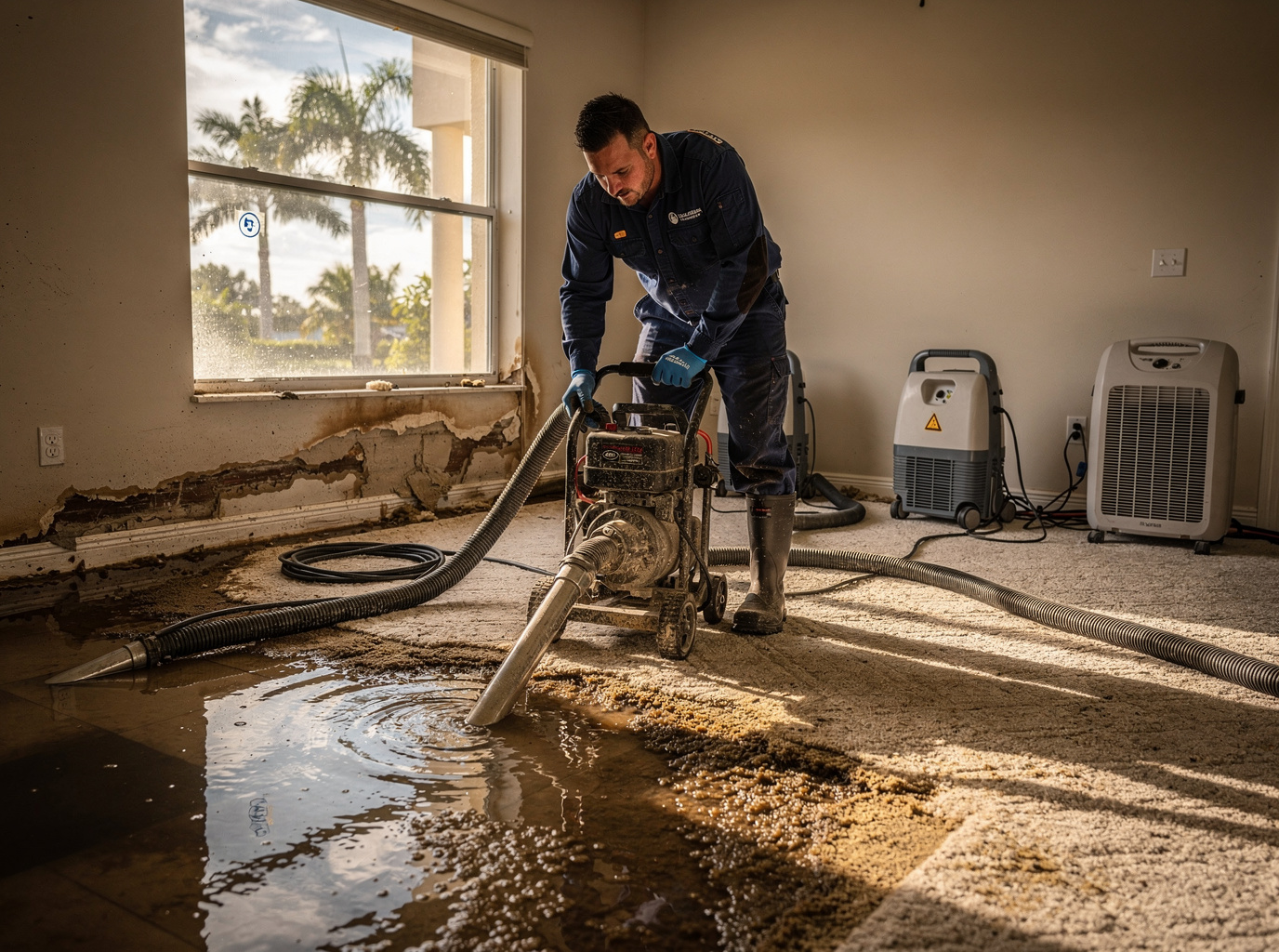
Standing water comes out first, using extraction equipment matched to the amount of water and the surfaces it has reached. Wet carpet and pad are often lifted and removed, and water that has reached wall bases and cabinets is pulled out wherever it sits. The water removal and extraction page explains this stage in detail.
4. Structural drying
Once the free water is gone, the structure still holds moisture inside walls, floors and ceilings. Drying uses dehumidification and air movement. Moisture readings are taken across the affected areas and checked again as drying proceeds. The structural drying and dehumidification page covers the equipment and monitoring in more detail.
5. Damaged-material removal and repair
Some material cannot be dried back to a usable condition. Swollen baseboards, soaked insulation, lifted flooring and drywall that has wicked water upward often come out. Affected areas are then repaired. Where flood rules apply, the paperwork the City asks for is raised with the owner early in this step, before rebuilding decisions are final. Repair detail is on the water damage repair page.
6. Close-out
The job finishes with final moisture verification, which confirms that the materials have reached readings showing the structure has dried. The owner receives the documentation from the job, including the photographs and drying records, so the history of the property is kept in one place.
What's Inside This Service
Restoration combines several stages, and four of them are described below. Each one is needed at a different point in the sequence, and each has its own cost drivers.
Water Removal and Extraction
Water removal and extraction is the stage that gets standing and saturated water out of the property. It is needed as soon as water is lying on floors or soaking into carpet, pad and the lower parts of walls. Truck-mounted and portable extraction equipment pull water from surfaces and from the materials that hold it. Truck-mounted units suit large volumes and wide floor areas, while portable extractors are used in tighter rooms and on specific surfaces. The scale of this stage is driven by the volume of water, how long it has been standing, the flooring types involved, the number of rooms affected, and how much material has to be lifted to reach water underneath. The dedicated water removal and extraction page owns the detail of this stage.
Structural Drying and Dehumidification
Structural drying is the stage that brings the building materials back to dry. It is needed once free water has been removed, because moisture stays inside drywall, insulation, subfloors and framing. Moisture mapping shows where that moisture sits, and moisture meters take readings inside wall cavities and in flooring systems, not only on the surface. Dehumidifiers and air movers are placed to work across those areas, and the readings are rechecked as drying proceeds, so progress is measured rather than guessed. Southwest Florida humidity makes this an active process, because warm, damp outdoor air can slow drying unless the equipment is managing moisture inside the property. The scale of the work depends on the area affected, the materials and wall build-ups involved, and how quickly the readings fall. The structural drying page explains the process in full.
Leak Detection and Source Control
Leak detection and source control is the stage that finds hidden supply and drain leaks and stops them. It is needed when water keeps arriving with no visible source, when a water meter keeps moving while nothing is running, or when wet materials show no clear origin. Investigation starts with the evidence on hand: meter readings, moisture patterns at accessible surfaces, and the location of wet areas relative to plumbing and appliances. Those clues narrow the search, so the team opens the smallest area needed to confirm the source rather than opening sections by guesswork. Once the leak is found, it is isolated or repaired so drying can begin on a property that is no longer taking in water. Cost depends on how hidden the source is, how many areas the evidence points to, and how much access must be opened to reach it.
Storm and Flood Intrusion
This block covers water that enters from outside, through wind-driven rain, roof and window failures, and surge or flood events. It is needed after heavy rain, after a storm, or when floodwater has reached the property. Water from these events can reach wall bases, flooring and mechanical areas. The water's category matters: clean water from a supply line is handled differently from water that has moved across ground or passed through contaminated areas. Sewage is a more serious category with its own handling, and we do not go into its detail here. Storm and flood jobs still run through the same core sequence: remove the water, dry the structure, take out what cannot be saved, and repair. Cost turns on the water category, the depth and duration of the water, and the materials involved.
Flood Zones, the 50% Rule and the Paperwork in Cape Coral
Cape Coral participates in the National Flood Insurance Program, and the City's flood rules apply to repairs after damage. The City's published checklist identifies high-risk areas on the Flood Insurance Rate Maps with the zone designations "AE" and "VE". Whether a particular property sits in one of those zones is something its owner should confirm for their own address.
The rule that catches many owners by surprise is the 50% rule, which the City's checklist calls substantial damage. Substantial damage means damage of any origin, including fire, flood, high wind, land movement or neglect, where the cost of restoring the building to its pre-damage condition equals or exceeds 50% of its pre-damage market value. Once a structure has been substantially damaged, any repairs are treated as substantial improvement, regardless of how much work is actually done. The building then has to meet full new-construction flood requirements, including the lowest floor and, where applicable, the lowest machinery at or above the minimum required elevation.
Market value for that test comes from one of two sources. It can be an actual cash value set by a qualified independent appraiser within 12 months, or the Lee County Property Appraiser's value adjusted to approximate market value. Condominiums must provide an appraisal, because county values are not currently available for them.
The substantial damage application, made up of an affidavit and a worksheet, is part of the building permit submittal. The applicant must provide photographs of the building, and those photographs play a critical role in the determination. Cape Coral is an incorporated jurisdiction, so this process runs through the City's permitting.
In practice, the owner should learn early whether the 50% test applies. Appraisal evidence and photographs are gathered before repairs are scoped. That is why the team documents damage as found and raises City requirements.
The National Hurricane Center's report on Hurricane Ian describes catastrophic storm surge along the Southwest Florida coast, including near the Caloosahatchee River. That was a regional event, and nothing on this page attributes local losses to it.
What Restoration Costs Depend On
Restoration scope varies widely from property to property, so this page describes what drives the work rather than publishing figures. These factors shape how much work a job involves.
- How much water entered, and how long it stood before it was removed.
- How many rooms are affected, and which materials, from flooring and drywall to cabinets and insulation.
- Whether the source is hidden, which adds investigation before drying can start.
- The water's category, since clean, outdoor and contaminated water are handled differently.
- How long drying takes, which depends on the materials, the moisture levels and conditions in the property.
- How much material must be removed and repaired to bring the property back to a usable state.
- Whether Cape Coral's substantial damage rules are triggered, which can change the scope of repairs and the paperwork involved.
Scope is established through assessment and documentation. The assessment comes first, the damage is recorded as found, and the owner sees the scope before restoration work proceeds. Two properties with similar-looking damage can need very different work. A wall that is wet at the baseboard but dry higher up may need only opening and drying at the bottom, while a cavity that has taken in water through a hidden leak may need wider removal and a longer drying period. Moisture readings, the type of materials and the water category are what separate those situations, and each reading is recorded so the owner can see why each step is included. Where repair costs approach the substantial damage threshold, the appraisal and permit requirements are raised early so rebuilding decisions are made with full information. The work is planned in stages, and owner decisions fit in at each point where they matter. To arrange an assessment, call Florida Water Damagesolution, and the team will explain what that visit covers.
Questions People Ask
What is the difference between water removal, extraction and water damage restoration?
Water removal and extraction is the stage of getting water out of the property, including standing water and water held in carpet, pad and lower wall areas. Extraction is one part of that stage, using truck-mounted or portable equipment. Water damage restoration is the whole sequence. It moves from source control through removal, structural drying, removal of material that cannot be saved, and repair of what was damaged, with documentation kept along the way. If you have standing water now, you are at the removal stage, and the full restoration sequence follows it.
Can a hidden leak be found without tearing out walls and floors?
Often, yes. Investigation starts with the evidence already available, such as a water meter reading that keeps moving, sounds, stains and moisture readings at accessible surfaces. Those clues narrow the search before anything is opened. Acoustic listening and thermal imaging are field tools used during that search. Targeted openings are then made where the evidence points, rather than opening walls on guesswork. Some investigations still need an opening to confirm the source, and that opening is kept as small as the evidence allows.
My Cape Coral home flooded during a storm. What happens first?
The first step is to keep clear of standing water and of any outlets or appliances it has reached, and turn off power only if it is safe. Then contact Florida Water Damagesolution to describe what happened. The team assesses the source and extent of the damage, and documents it with photographs as found before removal. Standing water is removed next, and the property moves into drying. Because the home is in Cape Coral, ask early about City flood requirements, since appraisal evidence and photographs matter if repair costs reach the substantial damage threshold.
What is the 50% substantial-damage rule in Cape Coral?
It is the City's substantial damage test. Damage of any origin, including flood, fire, high wind, land movement or neglect, counts when restoration cost equals or exceeds 50% of pre-damage market value. When that happens, any repairs are treated as substantial improvement, and the building must meet full new-construction flood requirements, including the lowest floor elevation. The application is part of the permit submittal and includes an affidavit, a worksheet and applicant photographs. Market value comes from a qualified independent appraisal or from the Lee County Property Appraiser's value adjusted to market.